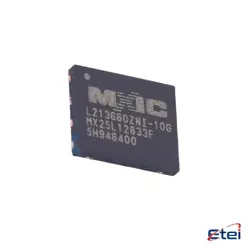
Изображения являются только для ссылки
MC68882EI16A
+БОМMATH COPROCESSOR, SUPPORTS MC680
-
ПроизводительСвободный полупроводник
-
Мфр. Часть #MC68882EI16A
-
Лист данных MC68882EI16A DataSheet
-
Пакет LCC-68
-
В наличии4862
365 Дни гарантии качества
7*24 часы обслуживания каранти
90-гарантия послепродажного дня
Гарантия подлинного продукта
Спецификации
| Атрибут | Ценность |
| Supplier | Rochester Electronics, LLC |
| Package / Case | Bulk |
| Part Status | Active |
| Type | Floating Point |
| Interface | SCI, SPI |
| Clock Rate | 16MHz |
| Voltage - Core | 5.00V |
| Operating Temperature | 0°C ~ 70°C (TA) |
| Mounting Type | Surface Mount |
Обзор
Description
The MC68882 improves computational performance by reducing the CPU's workload, allowing for faster processing in scientific, engineering, and graphics applications. It supports IEEE 754 standard for floating-point arithmetic, ensuring precision and compatibility across various systems.
Key features of the MC68882 include an independent instruction pipeline, which permits parallel processing with the host CPU, and a highly optimized internal architecture that reduces latency. The chip is housed in a 40-pin package, making it suitable for integration into a wide range of systems requiring enhanced floating-point performance. Overall, the MC68882EI16A is a robust solution for applications demanding high-speed mathematical computations.
Equivalent
Features
1. Performance: Offers enhanced computation capabilities for floating-point arithmetic, including addition, subtraction, multiplication, division, and square root operations.
2. Compatibility: Seamlessly integrates with the MC68020 and MC68030 processors, augmenting their capabilities without requiring significant system redesign.
3. IEEE 754 Compliance: Adheres to the IEEE 754 standard for floating-point arithmetic, ensuring consistent and reliable results across various computing environments.
4. Instruction Set: Provides an extensive set of instructions specifically optimized for mathematical functions, allowing for efficient processing of scientific and engineering applications.
5. Parallel Processing: Operates concurrently with the host CPU, thereby offloading complex calculations and enhancing overall system performance.
6. Clock Speed: The "16A" designation typically indicates a clock speed of 16 MHz, facilitating faster data processing compared to earlier models.
These features make it suitable for applications requiring high precision and speed in numerical calculations.
Pinout
Key functions of the MC68882 include:
1. Floating-Point Arithmetic: It performs high-speed floating-point calculations, such as addition, subtraction, multiplication, division, and square root.
2. Extended Precision: Supports single, double, and extended precision for floating-point operations, enhancing computational accuracy.
3. Instruction Set: The coprocessor is equipped with a rich instruction set specifically tailored for complex mathematical operations.
4. Parallel Processing: It operates parallel to the main processor, offloading math-intensive tasks to boost overall system performance.
5. Compatibility: The MC68882 is compatible with the MC68020, MC68030, and other processors in the 68000 family, making it versatile for various applications.
The 40-pin configuration of the MC68882 ensures it can be easily integrated into systems, offering a significant enhancement in computational efficiency for applications requiring intensive mathematical processing.
Manufacturer
Motorola, Inc. was well-regarded for its contributions to the semiconductor industry; however, it experienced significant restructuring over the years. In 2011, Motorola split into two separate entities: Motorola Mobility, which focused on consumer electronics like smartphones, and Motorola Solutions, which continued with enterprise and government communications technologies. The semiconductor division of Motorola became Freescale Semiconductor in 2004, which later merged with NXP Semiconductors in 2015.
Thus, the MC68882EI16A represents a legacy product from Motorola's earlier contributions to semiconductor technology.
Application
1. Scientific Computing: For complex calculations in research and simulations.
2. Engineering Applications: Enhances CAD/CAM software performance.
3. Graphics Processing: Supports graphic-intensive tasks and 3D rendering.
4. Embedded Systems: Used in systems requiring fast mathematical processing.
5. Telecommunications: Improves data processing in network equipment.
6. Aerospace and Defense: Used in avionics and defense systems for real-time calculations.
Its integration with a host CPU provides significant speed improvements in floating-point arithmetic operations, making it ideal for performance-critical applications.