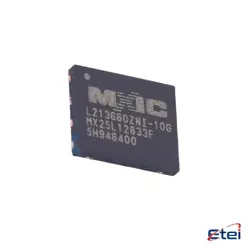
Изображения являются только для ссылки
MPR121QR2
+БОМIC CTLR TOUCH SENSOR 20-QFN
-
ПроизводительКомпания NXP USA Inc.
-
Мфр. Часть #MPR121QR2
-
Лист данных MPR121QR2 DataSheet
-
Пакет QFN-20
-
В наличии1208
365 Дни гарантии качества
7*24 часы обслуживания каранти
90-гарантия послепродажного дня
Гарантия подлинного продукта
Спецификации
| Атрибут | Ценность |
| Package / Case | Tape & Reel (TR),Cut Tape (CT) |
| Part Status | Discontinued at Digi-Key |
| Type | Buttons, Slider, Wheel |
| Proximity Detection | Yes |
| Number of Inputs | Up to 12 |
| LED Driver Channels | Up to 8 |
| Interface | I²C |
| Voltage - Supply | 2V ~ 3.6V |
| Supply Current | 393µA |
| Operating Temperature | -40°C ~ 85°C |
| Mounting Type | Surface Mount |
Обзор
Description
Key Features:
- Proximity Detection: Besides direct touch, it can detect proximity, enhancing the user interface experience.
- I2C Interface: Integrates easily with microcontrollers via an I2C communication interface, allowing for straightforward configuration and data retrieval.
- Adjustable Sensitivity: Offers adjustable sensitivity settings to accommodate various touch environments and materials.
- Built-in Noise Filtering: Includes advanced noise filtering capabilities to ensure accurate touch detection even in noisy environments.
- Low Power Consumption: Designed for low power usage, making it ideal for battery-powered devices.
Applications are diverse, including smartphones, home appliances, automotive systems, and industrial controls. Its compact design and versatility make it a popular choice for enhancing the interactivity and functionality of electronic devices.
Equivalent
1. TTP223 - A touch sensor IC used for similar capacitive touch applications.
2. AT42QT1011 - A single capacitive touch sensor by Microchip Technology.
3. CAP1208 - An 8-channel capacitive touch sensor by Microchip Technology.
4. CY8CMBR3116 - A capacitive touch sensing controller by Infineon Technologies.
These devices offer similar functionalities and can be used as alternatives in capacitive sensing applications.
Features
1. Touch Sensing: Supports up to 12 touch inputs, which can be used for touch pads, sliders, or proximity detection.
2. I2C Interface: Communicates via an I2C interface, allowing for easy integration with microcontrollers and other devices.
3. Adjustable Sensitivity: Sensitivity levels can be adjusted for each electrode, enabling customization for different applications.
4. Proximity Detection: Capable of proximity detection, allowing for actions based on the presence of an object near the sensor.
5. Low Power Consumption: Designed to operate efficiently with low power requirements, making it suitable for battery-operated devices.
6. Interrupt Output: Includes an interrupt output pin which can be used to notify the host processor of a touch event, reducing the need for constant polling.
7. Auto-Calibration: Features automatic calibration for environmental changes, ensuring consistent performance.
8. Operating Voltage: Functions within a voltage range of 1.71V to 3.6V.
These features make the MPR121QR2 suitable for a variety of applications, including consumer electronics, appliances, and industrial controls.
Pinout
- Pin Count: 20
- Function: The MPR121QR2 is designed to handle up to 12 touch inputs. It utilizes capacitive sensing to detect touch events and communicates with the host processor via an I²C interface. It supports various configurable features like proximity detection, touch thresholds, and debounce settings. The device includes pins for I²C communication (SDA, SCL), power supply (VDD, VSS), and interrupt signaling (IRQ). Additionally, the device has pins for electrode inputs (ELE0 to ELE11) for detecting touch on connected capacitive pads.
This sensor controller is used in applications requiring reliable touch sensing capabilities, such as smartphones, tablets, and other consumer electronics.
Manufacturer
NXP is particularly recognized for its innovations in secure connectivity, and it plays a significant role in advancing technologies related to the Internet of Things (IoT), smart cities, and secure car architectures. The company was originally part of Philips before being spun off in 2006 and has since grown through various mergers and acquisitions, including its significant merger with Freescale Semiconductor in 2015. NXP's focus is on creating solutions that enable secure connections and infrastructure for a smarter world, emphasizing safety, security, and environmental sustainability in its product designs.