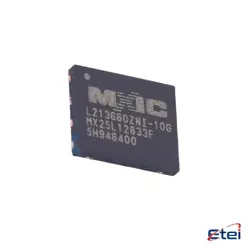
Изображения являются только для ссылки
STM32L151CBU6
+БОМIC MCU 32BIT 128KB FLSH 48UFQFPN
-
ПроизводительSTМикроэлектроника
-
Мфр. Часть #STM32L151CBU6
-
Лист данных STM32L151CBU6 DataSheet
-
Пакет UFQFN-48
-
В наличии5457
365 Дни гарантии качества
7*24 часы обслуживания каранти
90-гарантия послепродажного дня
Гарантия подлинного продукта
Спецификации
| Атрибут | Ценность |
| Package | Tray |
| Series | STM32L1 |
| ProductStatus | Not For New Designs |
| CoreProcessor | ARM® Cortex®-M3 |
| CoreSize | 32-Bit Single-Core |
| Speed | 32MHz |
| Connectivity | I²C, IrDA, LINbus, SPI, UART/USART, USB |
| Peripherals | Brown-out Detect/Reset, Cap Sense, DMA, I²S, POR, PWM, WDT |
| NumberofI/O | 37 |
| ProgramMemorySize | 128KB (128K x 8) |
| ProgramMemoryType | FLASH |
| EEPROMSize | 4K x 8 |
| RAMSize | 16K x 8 |
| Voltage-Supply(Vcc/Vdd) | 1.8V ~ 3.6V |
| DataConverters | A/D 16x12b; D/A 2x12b |
| OscillatorType | Internal |
| OperatingTemperature | -40°C ~ 85°C (TA) |
| MountingType | Surface Mount |
| Package/Case | 48-UFQFN Exposed Pad |
Обзор
Description
The microcontroller emphasizes energy efficiency, offering multiple low-power modes to extend battery life in portable devices. It supports a wide range of communication interfaces, like I²C, SPI, and USART, and includes a 12-bit ADC for analog signal processing.
Additionally, it features advanced security options, such as a true random number generator and CRC calculation unit. The STM32L151CBU6 is housed in a UFQFPN-48 package, which is compact and suitable for space-constrained designs.
This microcontroller is ideal for applications in health and wellness, smart meters, and wearable technology, where energy efficiency and robust performance are critical. Its comprehensive development ecosystem includes tools and software to facilitate streamlined prototyping and deployment.
Equivalent
1. STM32L152CBU6: Similar to STM32L151 but with an LCD controller.
2. MSP430 series from Texas Instruments: Known for ultra-low power usage.
3. ATSAML21 series from Microchip Technology: Offers comparable low-power performance.
4. EFM32 series from Silicon Labs: Designed for energy efficiency.
Each option should be evaluated based on specific requirements like peripherals, power consumption, and package type.
Features
Key features include:
1. Ultra-low power consumption:
- Sleep/Stop/Standby modes for energy efficiency.
- Ultra-low power consumption down to 230 nA in Standby mode.
2. Analog functionalities:
- 12-bit ADC, 12-bit DAC, and two ultra-low-power comparators.
3. Communication interfaces:
- Multiple USARTs, SPI, I2C, and USB.
4. Timers:
- 16-bit and 32-bit timers, including PWM and advanced-control timers.
5. Operating voltage:
- 1.8V to 3.6V.
6. Development support:
- Compatible with various development tools and environments.
The STM32L151CBU6 is well-suited for applications requiring low power consumption, such as portable and battery-operated devices.
Pinout
The STM32L151CBU6 is built around a 32-bit ARM Cortex-M3 CPU core and includes several features and functions:
1. GPIOs: Multiple general-purpose I/Os for connectivity.
2. Memory: 128 KB of Flash memory and 16 KB of SRAM.
3. Timers: Multiple timers including advanced control timers, general-purpose timers, and basic timers.
4. Communication Interfaces:
- USARTs for asynchronous communication.
- SPI for serial peripheral communication.
- I2C for inter-integrated circuit communication.
5. Analog Features:
- 12-bit ADC for analog-to-digital conversion.
- DAC for digital-to-analog conversion.
- Comparators.
6. Low-power Features: Various low-power modes for energy efficiency.
7. Security Features: Built-in security features to protect firmware.
These features make the STM32L151CBU6 suitable for a wide range of applications, especially where power efficiency is crucial.
Manufacturer
Application
1. Wearable electronics, such as fitness trackers and smartwatches.
2. Medical devices, including portable diagnostic equipment.
3. Consumer electronics, such as remote controls and wireless sensors.
4. Industrial automation, for efficient sensor nodes and control systems.
5. Home automation, for smart home devices like thermostats and security systems.
Its energy efficiency, integrated peripherals, and processing capabilities make it suitable for a wide range of embedded applications.