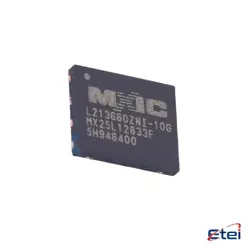
Изображения являются только для ссылки
ATSAMD20E17A-MU
+БОМIC MCU 32BIT 128KB FLASH 32QFN
-
ПроизводительТехнология микрочипов
-
Мфр. Часть #ATSAMD20E17A-MU
-
Лист данных ATSAMD20E17A-MU DataSheet
-
В наличии5393
365 Дни гарантии качества
7*24 часы обслуживания каранти
90-гарантия послепродажного дня
Гарантия подлинного продукта
Спецификации
| Атрибут | Ценность |
| Series | SAM D20E |
| Part Status | Active |
| Base Product Number | ATSAMD20 |
| DigiKey Programmable | Not Verified |
| Core Processor | ARM® Cortex®-M0+ |
| Core Size | 32-Bit |
| Speed | 48MHz |
| Connectivity | I2C, SPI, UART/USART |
| Peripherals | Brown-out Detect/Reset, POR, WDT |
| Number of I/O | 26 |
| Program Memory Size | 128KB (128K x 8) |
| Program Memory Type | FLASH |
| RAM Size | 16K x 8 |
| Voltage - Supply (Vcc/Vdd) | 1.62V ~ 3.6V |
| Data Converters | A/D 10x12b; D/A 1x10b |
| Oscillator Type | Internal |
| Operating Temperature | -40°C ~ 85°C (TA) |
| Mounting Type | Surface Mount |
| Supplier Device Package | 32-VQFN (5x5) |
| Package | 32-VFQFN Exposed Pad |
| Packaging | Tray |
Обзор
Description
The microcontroller provides up to 52 GPIO pins, offering flexibility in interfacing with other peripherals and sensors. It also includes a range of built-in features such as an RTC, multiple 16-bit Timer/Counters, and an Analog-to-Digital Converter (ADC) with up to 12-bit resolution. This makes it ideal for applications in consumer, industrial, and IoT domains that require efficient power management and real-time performance.
Packaged in a 32-pin QFN package, the ATSAMD20E17A-MU is a compact solution designed for space-constrained applications while ensuring robust performance and scalability for developers.
Equivalent
1. STM32F030K6T6 from STMicroelectronics: Offers ARM Cortex-M0 core and similar peripheral features.
2. NXP MKL16Z32VFM4: Part of the Kinetis KL16 series with an ARM Cortex-M0+ core.
3. TI MSP432P401R: From Texas Instruments, featuring an ARM Cortex-M4 core.
These alternatives may differ in some specifications, so compatibility checks are recommended.
Features
1. Core: It is powered by a 32-bit ARM Cortex-M0+ processor, which is designed for low-power, cost-sensitive applications.
2. Performance: Operates at up to 48 MHz, balancing performance with power efficiency.
3. Memory: Offers 128 KB of Flash memory and 16 KB of SRAM, suitable for embedded applications requiring moderate storage.
4. Peripherals: Includes a range of peripherals such as SERCOM modules (configurable as USART, SPI, or I2C), timers, RTC, ADC, and DAC.
5. Power: Supports low-power operation modes, including sleep and standby, optimizing battery-powered applications.
6. Package: Comes in a compact 32-pin QFN package, suitable for space-constrained designs.
7. Analog Features: Incorporates a 12-bit ADC and a 10-bit DAC for analog signal processing.
8. Connectivity: Provides options for I/O customization with its flexible pin multiplexing.
This microcontroller is ideal for consumer, industrial, and IoT applications where efficiency and versatility are required.
Pinout
The primary functions of the ATSAMD20E17A-MU include:
1. CPU: It has a 32-bit ARM Cortex-M0+ processor core.
2. Memory: It typically includes Flash memory and SRAM for storage and operational needs.
3. Peripherals: The microcontroller provides various peripherals, such as timers, serial communication interfaces (like UART, SPI, and I2C), and PWM channels.
4. GPIO: It offers general-purpose input/output pins, which can be configured for specific functions depending on the application requirements.
5. Analog Features: Includes ADC (Analog-to-Digital Converter) and DAC (Digital-to-Analog Converter) capabilities.
This microcontroller is suitable for a wide range of applications, including consumer electronics, industrial control systems, and other embedded system designs requiring low power consumption and compact size.
Manufacturer
Application
1. Consumer Electronics: Used in devices like remote controls and wearable tech due to its low power consumption.
2. Home Automation: Ideal for smart home devices, including lighting and thermostats, thanks to its efficient processing capabilities.
3. Industrial Automation: Utilized in applications requiring reliable and responsive control systems.
4. Internet of Things (IoT): Suitable for various IoT devices that require connectivity, low power, and compact size.
5. Automotive: Employed in non-critical automotive applications where compactness and power efficiency are essential.
These applications leverage the microcontroller's robust I/O capabilities, low power consumption, and flexible peripheral support.