
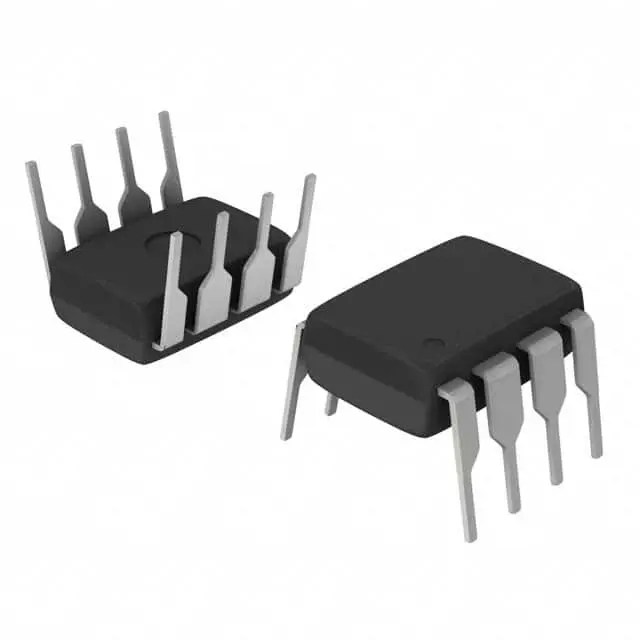
Изображения являются только для ссылки
Спецификации
| Атрибут | Ценность |
| Package / Case | Tape & Reel (TR),Cut Tape (CT) |
| Part Status | Active |
| Type | Clock/Calendar |
| Features | Alarm, Leap Year |
| Time Format | HH:MM:SS (12/24 hr) |
| Date Format | YY-MM-DD-dd |
| Interface | I²C, 2-Wire Serial |
| Voltage - Supply | 1.3V ~ 5.5V |
| Current - Timekeeping(Max) | 14µA ~ 30µA @ 3V ~ 5V |
| Operating Temperature | -40°C ~ 85°C |
| Mounting Type | Surface Mount |
| Memory Size | 1B |
| Voltage - Supply, Battery | 1.6V ~ 3.6V |
Обзор
Description
Key features include a programmable square wave output, battery backup to maintain time during power outages, and the ability to store time in both 12-hour and 24-hour formats. The DS1307 can also count seconds, minutes, hours, days, months, and years, supporting leap year calculations.
With a CMOS architecture, it offers low power consumption, making it ideal for battery-operated devices. Applications include clocks, data loggers, and any system requiring accurate timekeeping.
To use the DS1307, connect it to a microcontroller via I2C, configure its registers for the desired time format, and implement reading and writing functions to retrieve or set the time and date. Overall, the DS1307 is a reliable choice for embedded systems requiring precise timekeeping.
Equivalent
Features
1. Timekeeping: Maintains accurate time (hours, minutes, seconds) and date (day, month, year) information.
2. I2C Interface: Communicates via I2C protocol, allowing easy integration with microcontrollers.
3. Battery Backup: Supports a 3V battery backup for continuous operation during power outages.
4. 32.768 kHz Oscillator: Utilizes a crystal oscillator for precise timekeeping.
5. Leap Year Compensation: Automatically accounts for leap years in date calculations.
6. Alarm Function: Can generate alarms at specified times.
7. Temperature Compensation: Offers improved accuracy over a range of temperatures.
8. Power Consumption: Low power usage, making it suitable for battery-operated devices.
9. Programmable Square Wave Output: Generates a square wave signal for various applications.
10. User-Friendly: Simple to set up and program with minimal external components.
These features make the DS1307 ideal for applications requiring timekeeping capabilities in embedded systems.
Pinout
1. VCC (Pin 1): Supply voltage (typically +5V).
2. GND (Pin 2): Ground reference.
3. SCL (Pin 3): I2C serial clock input.
4. SDA (Pin 4): I2C serial data input/output.
5. SQW/OUT (Pin 5): Square wave output or interrupt output.
6. RST (Pin 6): Reset input (active low).
7. VBAT (Pin 7): Backup supply voltage for keeping the time when VCC is removed.
8. 32kHz (Pin 8): 32.768 kHz output, typically used for clock applications.
The DS1307+ provides accurate timekeeping and can be interfaced with microcontrollers via I2C, making it suitable for battery-backed applications.
Manufacturer
Application
1. Embedded Systems: Timekeeping in microcontroller projects.
2. Consumer Electronics: Alarm clocks, microwaves, and appliances requiring time tracking.
3. Data Logging: Timestamping events in data loggers and environmental monitoring systems.
4. Home Automation: Scheduling and time-based control in smart home devices.
5. Industrial Automation: Time-stamped events in manufacturing processes and equipment monitoring.
6. Automotive: Timekeeping in dashboard displays and vehicle systems.
7. Telecommunications: Synchronizing operations and logging events.
Its low power consumption and I2C interface make it versatile for these applications.
Package
Frequently Asked Questions
Q: What is the supply voltage range for the DS1307+?
A: The DS1307+ operates from 1.3V to 5.5V, making it suitable for low-power and battery-backed applications.
Q: Does this RTC support alarm and leap year functions?
A: Yes, it features an alarm output and automatically compensates for leap years up to 2100.
Q: What is the typical timekeeping current consumption?
A: It draws a maximum of 14μA to 30μA at 3V to 5V, ideal for battery-operated designs.
Q: What communication interface does the DS1307+ use?
A: It uses an I2C (2-wire serial) interface for easy connection to microcontrollers.
Q: What battery voltage range is required for backup operation?
A: A backup battery between 1.6V and 3.6V is required to maintain timekeeping when main power is lost.
Q: Is this component surface mount or through-hole?
A: Despite the PDIP-8 package code, the specifications show it is surface mount in an 8-SMD flat lead package.
Q: What time and date formats are supported?
A: It supports 12/24-hour format for time and YY-MM-DD-dd format for date, with AM/PM indicator.


