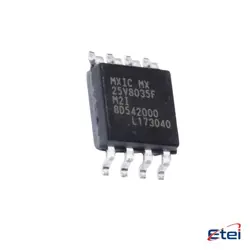
Изображения являются только для ссылки
GD25Q80CTIGR
+БОМIC FLASH 8MBIT SPI/QUAD I/O 8SOP
-
ПроизводительКомпания GigaDevice Semiconductor (HK) Limited
-
Мфр. Часть #GD25Q80CTIGR
-
В наличии8218
365 Дни гарантии качества
7*24 часы обслуживания каранти
90-гарантия послепродажного дня
Гарантия подлинного продукта
Спецификации
| Атрибут | Ценность |
| Part Status | Not For New Designs |
| Digi Key Programmable | Not Verified |
| Memory Type | Non-Volatile |
| Memory Format | FLASH |
| Technology | FLASH - NOR |
| Memory Size | 8Mbit |
| Memory Organization | 1M x 8 |
| Memory Interface | SPI - Quad I/O |
| Write Cycle Time - Word, Page | 50µs, 2.4ms |
| Voltage - Supply | 2.7V ~ 3.6V |
| Operating Temperature | -40°C ~ 85°C (TA) |
| Mounting Type | Surface Mount |
| Package / Case | 8-SOIC (0.154", 3.90mm Width) |
| Supplier Device Package | 8-SOP |
| Base Product Number | GD25Q80 |
| Clock Frequency | 120 MHz |
Обзор
Description
The GD25Q80CTIGR is a serial flash memory chip produced by GigaDevice, primarily used for storing data in embedded systems. It is an 8 Mbit (1 Megabyte) device, organized in a 1,048,576 x 8-bit configuration, and uses a standard serial peripheral interface (SPI) for communication, allowing for efficient data transfer with microcontrollers or processors. This chip supports various features like fast read capabilities up to 104 MHz, a uniform 4 KB sector erase, and dual/quad output and input commands for faster data throughput.
The GD25Q80CTIGR operates over a wide temperature range, making it suitable for various industrial applications. It has a low power consumption footprint, which is beneficial for battery-operated devices. The chip is compliant with JEDEC standards, ensuring compatibility with industry expectations. Its small form factor makes it ideal for space-constrained designs. Furthermore, it incorporates advanced security features, including block protection and a write protection mechanism, to ensure data integrity and prevent unauthorized access.
The GD25Q80CTIGR operates over a wide temperature range, making it suitable for various industrial applications. It has a low power consumption footprint, which is beneficial for battery-operated devices. The chip is compliant with JEDEC standards, ensuring compatibility with industry expectations. Its small form factor makes it ideal for space-constrained designs. Furthermore, it incorporates advanced security features, including block protection and a write protection mechanism, to ensure data integrity and prevent unauthorized access.
Equivalent
The GD25Q80CTIGR is an 8Mb (megabit) serial NOR Flash memory chip. Equivalent products include:
1. Winbond W25Q80DV - 8Mb serial Flash memory.
2. Micron M25P80 - 8Mb serial NOR Flash memory.
3. Cypress (formerly Spansion) S25FL008K - 8Mb serial NOR Flash.
4. Microchip AT25SF081 - 8Mb serial Flash memory.
These equivalents generally offer similar storage capacities and interfaces, but always verify specific specifications and compatibility.
1. Winbond W25Q80DV - 8Mb serial Flash memory.
2. Micron M25P80 - 8Mb serial NOR Flash memory.
3. Cypress (formerly Spansion) S25FL008K - 8Mb serial NOR Flash.
4. Microchip AT25SF081 - 8Mb serial Flash memory.
These equivalents generally offer similar storage capacities and interfaces, but always verify specific specifications and compatibility.
Features
The GD25Q80CTIGR is an 8 Mb (megabit) serial Flash memory device utilizing CMOS technology for high performance and low power consumption. Key features include:
1. Storage Capacity: 8 megabits (1 megabyte).
2. Interface: Serial Peripheral Interface (SPI), supporting standard, dual, and quad SPI modes for flexible communication.
3. Operating Voltage: Typically ranges from 2.7V to 3.6V.
4. Speed: Offers a high-speed clock rate of up to 104 MHz, enabling fast data transfer.
5. Architecture: Organized in 1,048,576 bytes with a 256-byte page size for efficient data management.
6. Erase Capability: Provides sector, block, and chip erase functions to support varied data management needs.
7. Endurance: Supports up to 100,000 program/erase cycles per sector, ensuring longevity.
8. Temperature Range: Operates within an industrial temperature range, typically from -40°C to 85°C.
9. Package: Available in space-efficient packages, suitable for various applications.
10. Security Features: Includes capabilities like write protect and unique ID for enhanced data security.
These features make the GD25Q80CTIGR suitable for applications in consumer electronics, industrial control, and other areas requiring reliable, high-performance memory solutions.
1. Storage Capacity: 8 megabits (1 megabyte).
2. Interface: Serial Peripheral Interface (SPI), supporting standard, dual, and quad SPI modes for flexible communication.
3. Operating Voltage: Typically ranges from 2.7V to 3.6V.
4. Speed: Offers a high-speed clock rate of up to 104 MHz, enabling fast data transfer.
5. Architecture: Organized in 1,048,576 bytes with a 256-byte page size for efficient data management.
6. Erase Capability: Provides sector, block, and chip erase functions to support varied data management needs.
7. Endurance: Supports up to 100,000 program/erase cycles per sector, ensuring longevity.
8. Temperature Range: Operates within an industrial temperature range, typically from -40°C to 85°C.
9. Package: Available in space-efficient packages, suitable for various applications.
10. Security Features: Includes capabilities like write protect and unique ID for enhanced data security.
These features make the GD25Q80CTIGR suitable for applications in consumer electronics, industrial control, and other areas requiring reliable, high-performance memory solutions.
Pinout
The GD25Q80CTIGR is an 8 Mbit (1 MByte) serial NOR flash memory chip, typically housed in an 8-pin package. The pin functions are as follows:
1. CS# (Chip Select): Activates the chip when low and deselects it when high.
2. DO (Data Out) / IO1: Outputs data during read operations; can be used for data input in dual/quad SPI modes.
3. WP# (Write Protect) / IO2: Protects certain parts of the memory from being written; used as IO in quad SPI mode.
4. VSS (Ground): Ground reference for power supply.
5. DI (Data In) / IO0: Inputs data during write operations; used for master data input in quad SPI modes.
6. CLK (Clock): Provides the clock signal for synchronizing data transfer.
7. HOLD# / IO3: Pauses serial communications without deselecting the device; used as IO in quad SPI mode.
8. VCC (Power Supply): Supplies power to the device.
This configuration allows for standard SPI communication and supports extended features like dual and quad SPI for faster data transfer rates.
1. CS# (Chip Select): Activates the chip when low and deselects it when high.
2. DO (Data Out) / IO1: Outputs data during read operations; can be used for data input in dual/quad SPI modes.
3. WP# (Write Protect) / IO2: Protects certain parts of the memory from being written; used as IO in quad SPI mode.
4. VSS (Ground): Ground reference for power supply.
5. DI (Data In) / IO0: Inputs data during write operations; used for master data input in quad SPI modes.
6. CLK (Clock): Provides the clock signal for synchronizing data transfer.
7. HOLD# / IO3: Pauses serial communications without deselecting the device; used as IO in quad SPI mode.
8. VCC (Power Supply): Supplies power to the device.
This configuration allows for standard SPI communication and supports extended features like dual and quad SPI for faster data transfer rates.
Manufacturer
The GD25Q80CTIGR is manufactured by GigaDevice Semiconductor, a company known for producing semiconductor products. GigaDevice is a leading provider of advanced memory solutions and microcontrollers. They specialize in the design and development of NOR Flash, NAND Flash, and other memory products, along with microcontrollers that are used in a wide range of electronic devices and applications. The company is recognized for its innovation in the semiconductor industry and is based in China, serving a global market.
Application
The GD25Q80CTIGR is an 8 Mbit (1 MB) serial NOR flash memory chip, commonly used in various applications due to its reliability, speed, and compact size. Key application areas include:
1. Consumer Electronics: Used in devices like digital cameras, TVs, and gaming consoles for firmware storage.
2. Industrial Systems: Employed in automation, control systems, and instrumentation for data logging and firmware updates.
3. Networking Equipment: Utilized in routers and switches for configuration data and firmware.
4. Automotive Electronics: Supports infotainment systems and other microcontroller-based applications.
5. IoT Devices: Provides storage for firmware and data in smart home devices, wearables, and sensors.
These applications benefit from its low power consumption and wide operating temperature range.
1. Consumer Electronics: Used in devices like digital cameras, TVs, and gaming consoles for firmware storage.
2. Industrial Systems: Employed in automation, control systems, and instrumentation for data logging and firmware updates.
3. Networking Equipment: Utilized in routers and switches for configuration data and firmware.
4. Automotive Electronics: Supports infotainment systems and other microcontroller-based applications.
5. IoT Devices: Provides storage for firmware and data in smart home devices, wearables, and sensors.
These applications benefit from its low power consumption and wide operating temperature range.
Package
The GD25Q80CTIGR is typically available in an 8-pin SOIC (Small Outline Integrated Circuit) package. This package is commonly used for surface-mount technology applications, providing a compact and efficient design suitable for various electronic devices.